

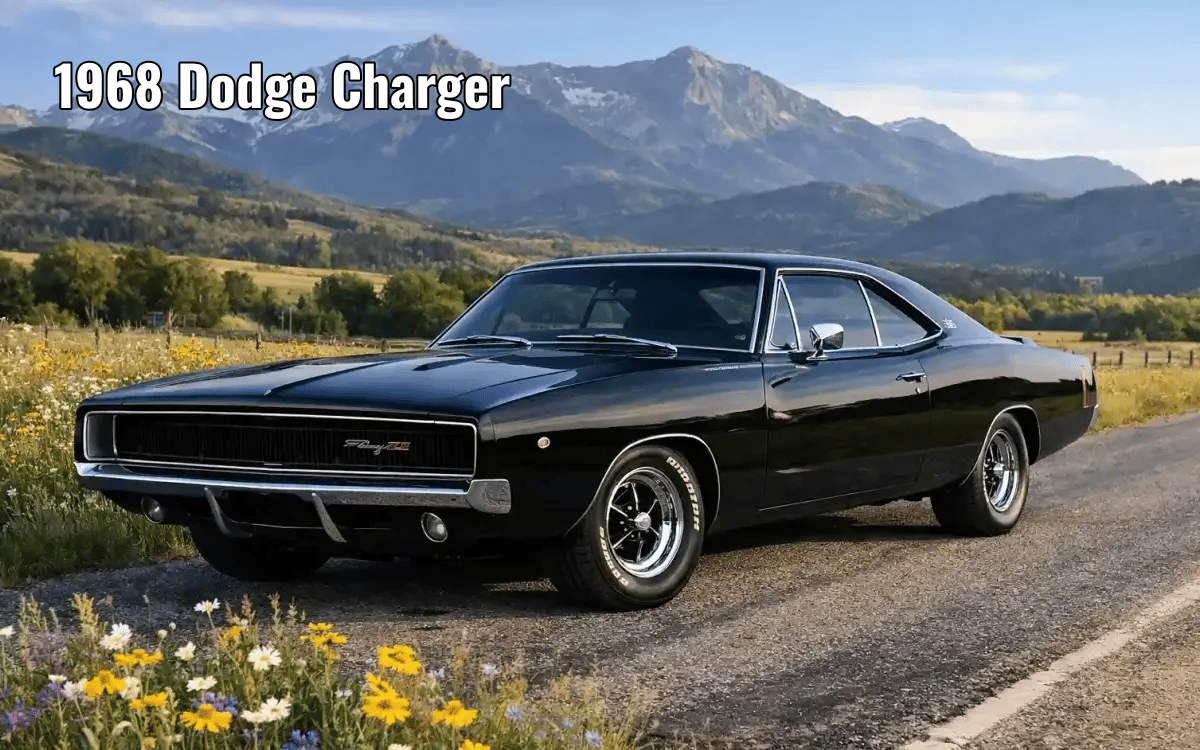
1968 Dodge Charger Facts: Design, Specs, and Legacy
This article was generated by an agent in Publish Owl using OpenAI's GPT-5 model with web search enabled. The agent researched and wrote the article according to a custom prompt and several style guides. Images were generated with OpenAI's GPT Image 1.5 model based on prompts from the context of the article. This article is just one example of what you can do with Publish Owl. Enjoy the read (if you enjoy reading AI-generated content haha)!
-----Picture a long, empty two-lane at dusk. The air smells like warm rubber and unleaded, the kind of evening where the horizon glows and the streetlights haven’t quite woken up. In the distance, a deep, steady thrum rolls toward you, then a sharper bark as a big secondary opens and the whole night seems to lean in. That shape streaking past with a tunneled backlight and a jawline grille is the 1968 Dodge Charger. It does not hurry. It prowls. And it has more stories than a Saturday night at the strip, which is exactly why this legend still hijacks conversations and hearts in the same breath.
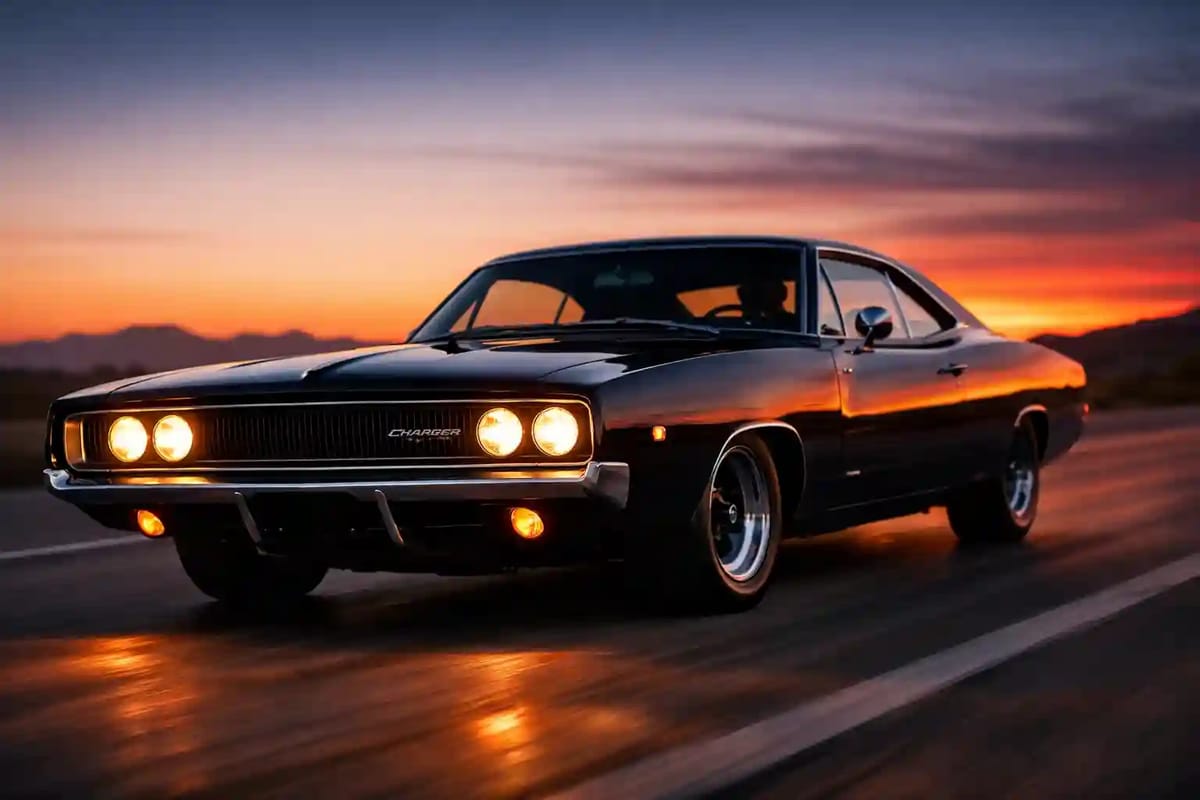
Table of Contents
Fact 1: The Coke-bottle makeover and those flying buttresses
Fact 2: A sales earthquake that forced a second assembly plant
Fact 4: Engines that read like a Mopar mixtape, from 318 to 426 Hemi
Fact 12: The Charger 500 was a 1968 problem solver wearing 1969 clothes
Fact 13: Bullitt turned the Charger into cinema’s best villain car
Fact 15: Three pedals, two pedals, and a lot of torque in between
Fact 18: Fuel capacity and the sound of range anxiety at 10 mpg
Fact 19: The flip-top fuel cap that looked ready for pit lane
Fact 20: Colors, vinyl tops, and how dark paint turned menace into myth
Fact 22: Slant-six unicorns exist, but you almost never see one
Fact 23: Real-world performance that felt stronger than the brochure
Fact 1: The Coke-bottle makeover and those flying buttresses
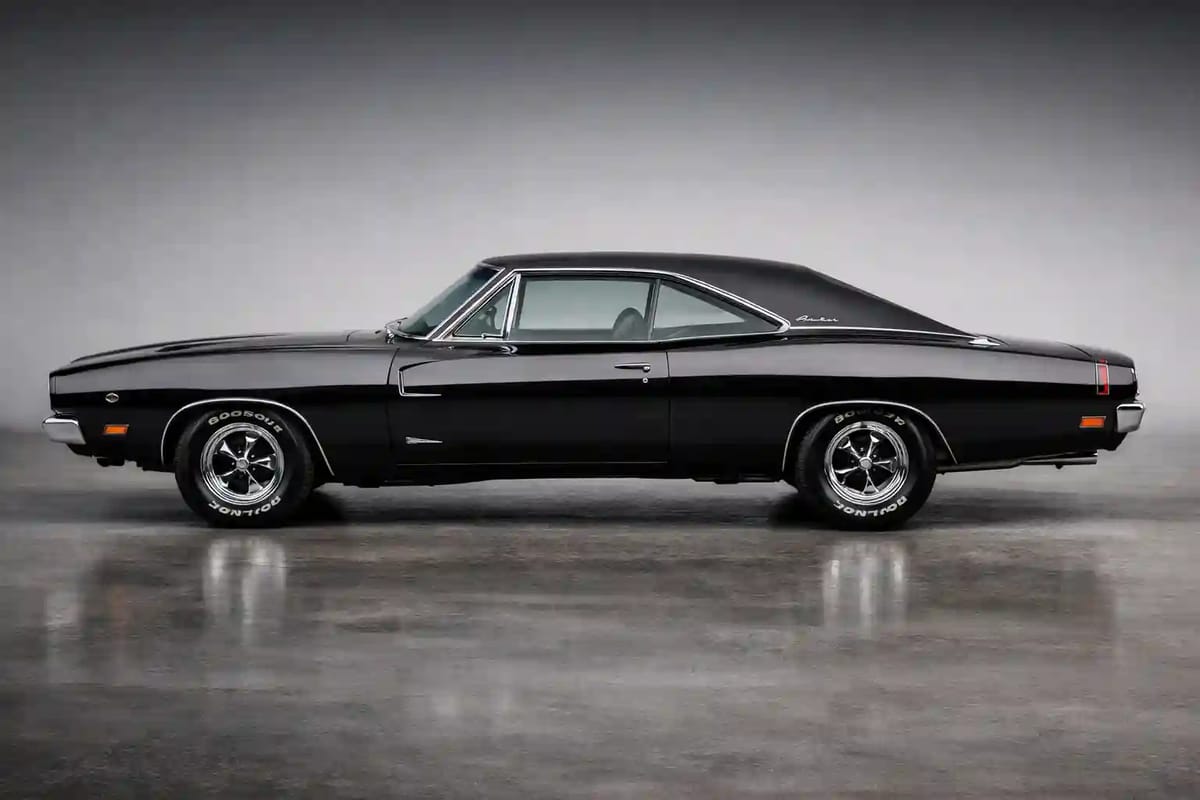
Look at a ’68 Charger in profile and the body pinches at the doors, then swells over the rear quarters like a weightlifter flexing in slow motion. The roof sweeps into flying buttresses that tunnel the backlight, which gives the car a sinister glare even when it is parked. The hidden-headlamp grille turns the whole nose into a single black blade until the lights pop open with a soft hiss, which feels like theater every time you flick the switch.
Fact 2: A sales earthquake that forced a second assembly plant
Dodge thought it would sell about 35,000 units. Reality laughed. Demand went stratospheric, past 96,000 cars for 1968, and it was so wild that production expanded beyond Hamtramck to St. Louis to keep up. More than 17,000 were R/Ts, which meant a sea of bumblebee stripes in dealer lots and new bragging rights at every stoplight, a rush that felt like a fresh V-8 tune on a Friday night. See the surge and R/T share in period context via Hemmings’ 1968 Charger R/T profile.
Fact 3: The designer who finally got his due
That shape did not just happen. Designer Richard Sias pushed a “double-diamond” theme that became the Coke-bottle Charger, and while credit politics swirled back in the day, history now points to Sias as the prime mover behind the look that made sales explode. Imagine being 26, carving clay that ends up as every kid’s poster for the next half-century, then watching it stomp the sales charts while the exhaust crackle bounced off showroom glass. The story and politics are unpacked in Hemmings’ deep dive on Richard Sias.
Fact 4: Engines that read like a Mopar mixtape, from 318 to 426 Hemi
The 1968 menu hits all moods. A 318 two-barrel hums along with easy torque for cruising. The 383s, in two- and four-barrel form, add a throatier yowl and light up the tires with a jab. The 440 Magnum is the sweet, angry middle, all 375 hp worth of big-block punch from idle. And the 426 Hemi, underrated at 425 hp, is the deep-chested thunderclap that makes street signs vibrate. Very few 1968 cars got the Hemi, so hearing a real one today is like spotting lightning twice on the same road.
Fact 5: The R/T formula, stripes, and the Scat Pack swagger
R/T stood for Road/Track, but really it meant serious intent. A 440 Magnum standard, the Hemi optional, heavy-duty suspension, dual exhaust, and the bumblebee tail stripe that shouted from a block away. Most were black, white, or red stripes, and plenty of buyers kept them on because it looked like factory attitude baked right into the sheetmetal, the kind of detail you catch in your peripheral vision and grin at a block later.
Fact 6: VIN tells all, and XS29 is the magic prefix
Charger VINs speak Mopar if you know the code. “X” tags a Charger. “S” flags R/T. “29” means two-door sports hardtop. Fifth digit reveals the engine. So an XS29L8… is a 1968 Charger R/T with a 440, while XS29J8… means a Hemi R/T. If a seller’s story sounds heroic, the VIN backs it up like a dyno sheet, which is exactly why Mopar folks decode before they daydream. Use this quick explainer as a guide: Classic Industries’ Mopar VIN decoder.
Fact 7: Hidden headlamps that run on vacuum and attitude
Unlike 1966–67’s electric rotating buckets, the 1968 hides lights behind a vacuum-operated grille door. It is cool and clean until a wild cam and low idle vacuum slow the motion to a sleepy wink. Plenty of owners quietly convert to modern actuators, but when the factory system is dialed, watching those doors glide open feels like a magic trick that never gets old.
Fact 8: Round taillights for 1968 only
The second-gen Charger story is easy to read from behind. Dual round lamps live only on 1968. In 1969, the rear panel goes to a full-width treatment, and in 1970 the bumper and face change again. Catch a pair of circles glowing red in a dark tunnel and there is no mistaking which year just downshifted, which is the whole fun of spotting one in the wild.
Fact 9: Dimensions that give the stance its menace
On paper it is 208 inches long, 76-plus inches wide, and rides a 117-inch wheelbase. In person it looks lower and longer because the body tapers and swells in all the right places. A base 318 car is roughly 3,450 pounds, while big-block and Hemi versions add mass like a barbell plate, all of which you feel when the nose rises and the rear squats with that first full-throttle pull. Key dimensions and curb weights are captured here via period-correct data: automobile-catalog’s 1968 Charger specs.
Fact 10: Tires, wheels, and the F70-14 reality
Factory rubber for most 1968 Chargers was F70-14 bias-ply on 14-inch wheels. Many cars wore Magnum 500s, and a set of meaty rear tires plus a slight rake gave the Charger its brawler stance at the curb. On today’s radials the car feels calmer on the highway, but the look is still pure Saturday-night cruise, which is the point when you are rolling under neon and listening to big-block idle through glasspacks.
Fact 11: The tunneled rear glass made NASCAR crazy
That gorgeous flying-buttress backlight was not ideal for stock car aerodynamics. At 180 mph it trapped air and made lift, so crews taped seams and blocked grilles in a frantic search for clean flow. It worked on Friday. It did not on Sunday. The lesson was coming, along with bigger fixes that would change the whole nose and roofline, a classic example of style meeting speed and both sides learning something.
Fact 12: The Charger 500 was a 1968 problem solver wearing 1969 clothes
Dodge’s answer debuted for 1969, but the fix was hatched in mid-1968: a flush-mount grille and a reworked, flush backlight to bleed off turbulence. Early press cars were literally 1968s modified to preview the new 500, a behind-the-scenes hack that shows how quickly NASCAR pressure can reshape a showroom car when trophies are on the line. See how Dodge framed it, and why 1968 racing forced the change, in this DodgeGarage look at the aero cars.
Fact 13: Bullitt turned the Charger into cinema’s best villain car
When moviegoers watched a black ’68 Charger R/T spar with Steve McQueen’s Mustang on San Francisco’s hills, the Charger became the baddie everyone secretly loved. The soundtrack was 440 Magnum thunder, hubcaps flew, and the car looked lethal in every cut. Crowds walked out of theaters and straight into Dodge showrooms, the kind of word-of-mouth that no ad budget can buy, which is exactly what happened in 1968.
Fact 14: Hamtramck and St. Louis built the wave
Early runs came out of Hamtramck, Michigan. Then, when orders exploded, St. Louis joined the party to keep dealers from starving for inventory. If you have ever waited months for the exact car you want, imagine doing that in 1968 while your buddies were already cruising theirs. Patience was tough, but the payoff sounded like open headers on a cool night.
Fact 15: Three pedals, two pedals, and a lot of torque in between
Base cars could be ordered with a three-speed manual, but most buyers stepped up to the four-speed A833 or the 727 TorqueFlite, which shifts with a crisp thunk that feels carved from billet. The four-speed makes every on-ramp a ceremony, while the TorqueFlite is that fast, unfussy friend who always shows up on time, a perfect match for a torquey 440 that pulls from idle like a freight train leaving town.
Fact 16: The Rallye dash and the “Tic-Toc-Tach” party trick
The Rallye gauge cluster is a Charger signature. The unicorn option inside it is the “Tic-Toc-Tach,” a tachometer with a clock in the center, the kind of period flourish that makes owners point and smile at cars and coffee. It is both cool and useful. It tells you when to grab the next gear and when you are late to dinner after a detour that somehow ran past the county line.
Fact 17: Brakes, suspension, and the classic Mopar feel
Underneath, a Charger feels like a Mopar should. Torsion bars live up front, leafs ride out back, and the car lifts its chin under throttle like it is proud of what it is about to do. Eleven-inch drums were common, with front discs optional. Period tires will keep you honest, while modern compounds transform freeway manners without numbing that old-school feedback through the wheel.
Fact 18: Fuel capacity and the sound of range anxiety at 10 mpg
The 19-gallon tank is generous on paper. On a 440 or Hemi it just means more time between happy fuel stops. Watch a strong big-block sweep past 4,000 rpm on a long pull, listen to the exhaust harden, and try not to glance at the gauge. It is a losing game. The best move is to plan for a fuel stop near a diner with pie, which is what smart Charger owners do on Saturday runs.
Fact 19: The flip-top fuel cap that looked ready for pit lane
High on the left rear quarter sits a flip-top cap that looks like a race car detail. It is overbuilt, tactile, and perfectly placed for a quick top-off before another pass down the boulevard. Kids tap it with a finger like a lucky charm. Grownups hit the chrome with a microfiber and smile at the reflection while the pump clicks and the fumes turn the clock back decades.
Fact 20: Colors, vinyl tops, and how dark paint turned menace into myth
1968 brought a full palette and a wave of vinyl tops that framed the buttress roofline like a suit collar. Dark colors make the body lines read like shadow and light, which is why blacked-out Chargers look like trouble even when idling. The way the stripe cuts across the quarters is pure graphic design, the kind you can read at 50 mph in your side mirror.
Fact 21: A base price that made temptation affordable
Sticker shock was not the point in 1968. The base Charger slotted right around the three-grand mark, which put a lot of kids within reach if they had a decent job and a friendly banker. Plenty left the dealer with a 383 and a payment book, then added wheels, glasspacks, and gears in the driveway to make it theirs one Saturday at a time.
Fact 22: Slant-six unicorns exist, but you almost never see one
Midyear, the humble 225 slant-six slipped onto the order form. They are ultra-rare in the wild, and spotting one feels like running into a celebrity in sweats at the grocery store. Most buyers ordered V-8s, of course, but the existence of a six-cylinder Charger proves that even the meanest-looking sheetmetal can be paired with a mellow heart if you ask nicely.
Fact 23: Real-world performance that felt stronger than the brochure
Period tests of 440 R/Ts ran low 14s in the quarter on skinny tires, and Hemi cars dipped into the high 13s when the air was right. The numbers are great. The sensation is better. A 440 Charger hammers out of a corner with a fat, smooth rush that feels faster than the stopwatch suggests because the whole car squats and talks to you through the seat and the steering rim.
Fact 24: Why 1968 remains the sweet-spot year for so many
One-year-only cues, the cleanest grille, round taillights, and the purest take on the Coke-bottle theme make 1968 the model-year people imagine when they hear “Charger.” It is the car that put Dodge at the center of the muscle conversation. For some, the ’69’s face or the ’70’s details win the beauty contest. For many, 1968 is the voice that rumbles first when memory hits play.
Line a 1968 Charger next to anything from its era and it still looks like the car that knew exactly what it wanted to be. It is long and low without being delicate. It is loud without shouting. Most of all, it feels personal. Every one tells its owner’s story the moment the key turns and the tach needle wakes up, which is why the legend never idles down.
Related Articles

Run Multiple Claude Code Agents in Parallel with Git Worktrees and Automation
How to run multiple Claude Code agents in parallel with git worktrees. Article generated by a Publish Owl agent based on a YouTube video.

Best Wireless Routers 2025 - Buyer's Guide
An example "best of" Amazon buyer's guide generated by an agent in Publish Owl. Find the best metal detector on Amazon based on Perplexity's research!

Anything AI Review: Can This No-Code AI App Builder Deliver on Its Promise?
Anything AI review by Publish Owl. This review explores its features, ease of use, and autonomous testing capabilities, helping you decide if it’s the right tool for your development needs.